
Monday, February 25, 2013

Thursday, February 14, 2013
Superbowl Commercial
This commercial, named whisper fight is definitely my favorite commercial of the Superbowl I like it because I, personally (along with most people) can relate to having to be quiet in the library.

The shopping list:
4 - 5.5ft length
4 - 3.5ft height
7 - 3ft width
2 - 2ft dia-inter
2 - 2ft len-inter
2 - 1ft hi-inter
3 - 2ft reinforce
1 - 3.5ft reinforce
----------------------------
Joints/connectors
----------------------------
4 - T
4 - L
2 - T
2 - 45° T
2 - T
2 - T
4 - L
2 - L
Mesh
Velcro
This is not the final shopping list but more of a rough estimation.
Friday, January 18, 2013
Minecraft Screenshots


Complete with chimney, toggle-able lights, outside lights that turn on during the day, a stove, a fridge, and a bed!
Tuesday, January 15, 2013
Architectural Styles
Today in Engineering, we took notes on famous architects and their style of building. Here is what I wrote:
Luis Vanderloi
Luis Vanderloi
- "less is more"
- Minimal structure to allow more light in
S'jin Tokimatsu
- Unusual industrial buildings
- "Futuristic factory look"
Andrea Poladio
- Symmetry, clarity, used rules
- Wrote 4 books on architecture
Eitonne Boulle
- Greek and roman, but giant
- Organizational, largeness, austerity
Le Corbisier
- Rethinking conventional architecture
- Changed uniformity
Frank Furness
- Victorian, but bolder
- Powerful, quirky, over sized
Frank Lloyd
- Organic, free flowing, long overhangs
- Used ornaments and surrounding landscape
Antoni Goudi
- Curvy, fluid, a break from traditions
- Based on botanical and geographical forms
Todou Anda
- Bold, serious, thoughtful, brutal
- Use of concrete, water, and light
Coop Hindlebrau
- Deconstructionism, form over function
- Jumbled and random
Friday, December 7, 2012
Puzzle Cubes
For the last few weeks in engineering class, we fabricated puzzle cubes, made of 27 identical wooden cubes that we glued together and colored, arranged to be a 3x3 cube. First, we had to sketch out possible combinations:


How to Assemble my cube:
This picture is a cross section of my cube, leveled from the bottom to the top.
To put it together, follow these steps from left to right:


We also modeled all of our cubes in Autodesk Inventor, which included learning how to protrude objects, place objects, create assemblies, and constraints.

We also learned how to animate the cube, and in this case, we exploded it so that you can see how all of the parts going together.
Modeling the cubes in CAD was a lot of fun, and I hope to get better at it in the future.
After this all was done, we made Boxes out of Manila folders for protection and transport, and to keep them together.

The puzzle cubes were a lot of fun, and I can't wait to see what we're doing next.
After this all was done, we made Boxes out of Manila folders for protection and transport, and to keep them together.

Sunday, October 21, 2012
Cardboard Canoe
Five Achievements Overall
Achievements:
• Sketch Ideas - Draw 3 different sketches for possible designs. Label at least 3 key features for each sketch. Describe the feature's functionality so a viewer understands why the called out feature is important.
• Define the Problem and Brainstorm Solutions - State the problem you are designing a solution for. List at least 20 ideas you have regarding your solution.
(Speed, or balance, v bottom? outrigger, shape, buoyancy, double the sides, double the back, tripe the bottom, u-bottom?rudder, paddle, no paddle, 3 ft tall sides, 3 and 1/2 ft. nose, get pushed by swimmers?, try to get the balance master, have all team swim.)• Videographer - Take video of the challenge and post to your blog.

• Criteria & Constraints - List or reference the specified Criteria and Constraints you're designing for. List at least one implied criteria. List at least three implied contsraints.
(the canoe had to be made out of only cardboard, had to be covered by duck tape all around, and it had to be able to fit at least one skipper.• The Constraints where that you could only use Cardboard and Duct Tape, All Staples or other foreign material must be removed from your cardboard. We had to respect the pool and we couldn't trash it. Cardboard must meet our quality standard and be approved by the instructor Each boat must have a minimum of a 3" tall "sidewall," All exposed cardboard must be covered in duct tape)• Select an Approach - Generate feedback (+, change, ?, !) and make a decision matrix regarding your sketches/prototypes. Specify the approach you've chosen and justify your selection.(All of our designs were designed for a purpose. we designed three completely different designs so that we could think of all the positives and negatives to build the best canoe we could. We chose to go with our outrigger from design 3 on our main design. We chose this because we want our canoe to be sturdy and be very balanced. We decided not use a V bottom because or skipper wanted balance over speed. Our dimensions actually played a huge role in constructing our boat. the three different prototypes all had different dimensions so we took dimension from prototype 1 for the back and we used dimensions from prototype 2 for the sides and nose (front) of our boat. )
• Prototype Ideas - Craft physical prototypes (models) of each of your three sketches. Use a notecard or post it note to call out at least one key feature on each model. Post the images to your blog and describe the key feature that you've pointed out on each.
• Build It! - Build your watercraft. Your build must meet the standards of construction (100% covered in Duct Tape). Document it with a presentable photo.
• Balance Master - Awarded if you can have at least one person stand for 5 seconds in the boat (you must conduct this away from the edge of the pool so that non one falls over and hits their head)
• Feedback - Generate ten items of feedback for your effort (from the design/build process and/or the actual product). Make sure you include at least one item of feedback in each of our four feedback areas (+, change, ?, !)
(I thought our team worked very well together in all stages of the Cardboard Canoe challenge. I wasn't expecting the building process to be as tedious and precise as it was. We had to make sure all the dimensions and angles added up. I also didn't expect the but to be as light as it was. one thing i loved about the design process was making the outrigger and making prototypes. One thing I didn't like at the start was how every square inch had to be covered, but once we got in the water I realized it was actually necessary and that cardboard water logs really easily. I loved the finished product of our boat and the flames. Another thing I really enjoyed was my teams patriotic feel. We told Sam that his was racing for something bigger than himself, we told him we was racing for Amurrica. One thing I would of changed might have been to triple the bottom instead of doubling it.)• Criteria & Constraints - List or reference the specified Criteria and Constraints you're designing for. List at least one implied criteria. List at least three implied contsraints.
(the canoe had to be made out of only cardboard, had to be covered by duck tape all around, and it had to be able to fit at least one skipper.• The Constraints where that you could only use Cardboard and Duct Tape, All Staples or other foreign material must be removed from your cardboard. We had to respect the pool and we couldn't trash it. Cardboard must meet our quality standard and be approved by the instructor Each boat must have a minimum of a 3" tall "sidewall," All exposed cardboard must be covered in duct tape)• Select an Approach - Generate feedback (+, change, ?, !) and make a decision matrix regarding your sketches/prototypes. Specify the approach you've chosen and justify your selection.(All of our designs were designed for a purpose. we designed three completely different designs so that we could think of all the positives and negatives to build the best canoe we could. We chose to go with our outrigger from design 3 on our main design. We chose this because we want our canoe to be sturdy and be very balanced. We decided not use a V bottom because or skipper wanted balance over speed. Our dimensions actually played a huge role in constructing our boat. the three different prototypes all had different dimensions so we took dimension from prototype 1 for the back and we used dimensions from prototype 2 for the sides and nose (front) of our boat. )
• Prototype Ideas - Craft physical prototypes (models) of each of your three sketches. Use a notecard or post it note to call out at least one key feature on each model. Post the images to your blog and describe the key feature that you've pointed out on each.
• Build It! - Build your watercraft. Your build must meet the standards of construction (100% covered in Duct Tape). Document it with a presentable photo.
• Balance Master - Awarded if you can have at least one person stand for 5 seconds in the boat (you must conduct this away from the edge of the pool so that non one falls over and hits their head)
• Feedback - Generate ten items of feedback for your effort (from the design/build process and/or the actual product). Make sure you include at least one item of feedback in each of our four feedback areas (+, change, ?, !)
• How Low Did You Go? - How low in the water did your canoe sit (roughly)? Was it surprising how little your boat went down in the water? What is the unit weight of water in pounds? How much did your pilot weigh (roughly)? Use math to help explain the depth that your boat sat in the water.
(Our canoe was probably in the water for 15 minutes. It was very surprising how little our boat went down in the water. Our pilot weighed around 105 pounds. Our boat sat in about i foot in maybe 8 inches in the water. using Same as our skipper was a strategic move so we could try and build a smaller faster boat. We also did 5 laps, 125 meters, before sinking to our tragic death.)• Redesign - If we were to do another Cardboard Canoe race next semester, what would you build? Draw from everything you experienced in your class and propose the most competitive solution. Include a sketch with key features and dimensions labeled.
(If i were to redesign a boat for next semester i would do it completely different. i actually grew inspiration from seeing Landry's boat in per. 5. i would make my boat similar to that style. more like a canoe shape that is no longer than 3 ft wide and very long. i gained some important knowledge from my first canoe like speed and balance have to be in a perfect harmony to have a amazing canoe, and that cardboard water logs very easily.)• "Patriotic" Have the most 'MURRICAN flags on your boat (automatically win the competition)
For the past few weeks in engineering class, we have worked on making canoes completely out of cardboard and duct tape. First, we brainstormed both on paper and in a paint program, and we decided our "gimmick" would be that we would put an outrigger sticking out from the side. After we decided that, we made a crude model, and put an Easter egg as a makeshift captain of this boat. We named him 'Jose' on account of his awesome mustache.


(If i were to redesign a boat for next semester i would do it completely different. i actually grew inspiration from seeing Landry's boat in per. 5. i would make my boat similar to that style. more like a canoe shape that is no longer than 3 ft wide and very long. i gained some important knowledge from my first canoe like speed and balance have to be in a perfect harmony to have a amazing canoe, and that cardboard water logs very easily.)• "Patriotic" Have the most 'MURRICAN flags on your boat (automatically win the competition)
For the past few weeks in engineering class, we have worked on making canoes completely out of cardboard and duct tape. First, we brainstormed both on paper and in a paint program, and we decided our "gimmick" would be that we would put an outrigger sticking out from the side. After we decided that, we made a crude model, and put an Easter egg as a makeshift captain of this boat. We named him 'Jose' on account of his awesome mustache.

After we decided that the first model was too buoyant, we decided to scale it down. We then decided to make it so one inch scale = 1 foot, so that we could compute how much weight to put in the egg so that it is the correct amount of weight.

In this model, we decided to record the shape and folds of the model so that we could cut it into cardboard and fold, instead of taping every side with duct tape. We also decided that the nose cone was too short, so we needed to make one more model. We could not find a picture of this last model, but it looked essentially the same but with a bigger nose.

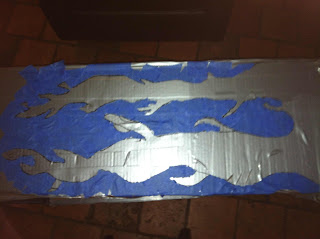
After we built the canoe to the specifications we made on our blueprints, we decided we needed to add an intimidation factor, so we took it home and traced flames onto the side. We then covered what we did not want painted with painter's tape, then spray painted on flames. We also add 2 american flags to the back of it, since we were team 'MURRICA
Subscribe to:
Posts (Atom)